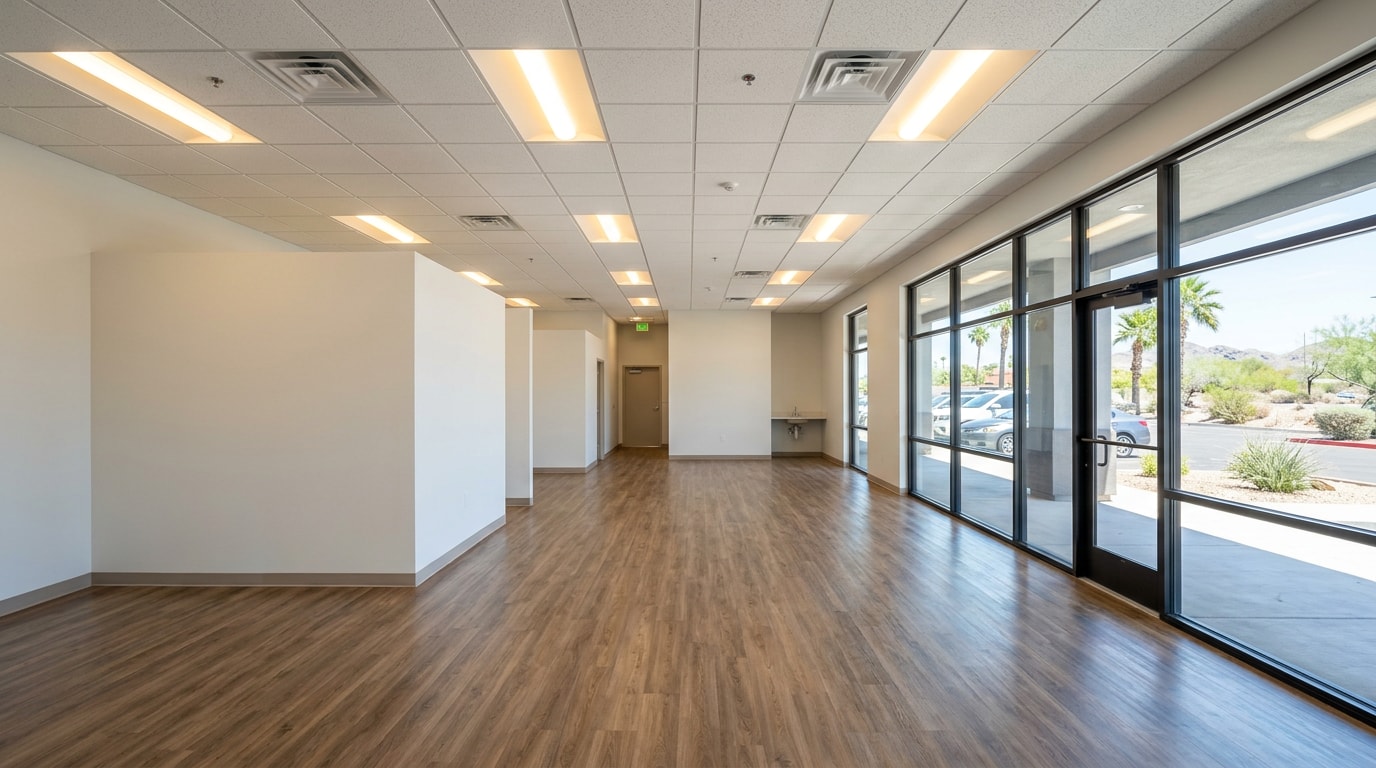
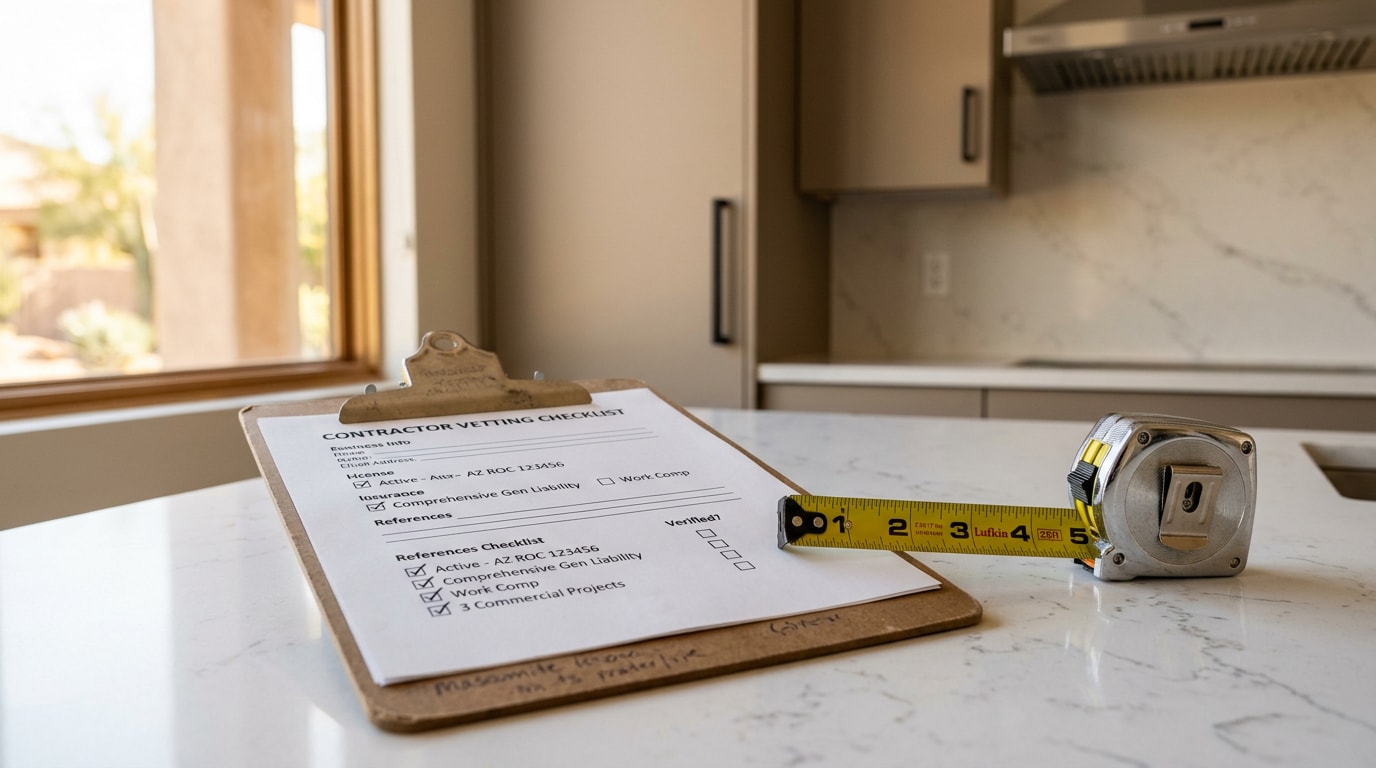
This general contractor checklist Glendale, AZ homeowners can carry into a meeting starts with one question: is the license real, active, and in the right classification? Everything after that protects your deposit, your permit, and your ability to collect if the job goes sideways. Work it in order and the wrong contractor usually removes himself by the second conversation.
The 10-Point Checklist at a Glance
- Active Arizona ROC license, correct classification, matching legal name
- Current bond and clean or explainable complaint history
- Certificate of insurance sent directly by the carrier or agent
- Documented experience with your exact project type nearby
- References you can call and a finished job you can walk
- Written answer on who self-performs and who subs out
- Three detailed bids normalized to identical scope
- Written contract with scope, allowances, dates, and warranty
- Permit responsibility and inspection schedule in writing
- Milestone draw schedule, lien waivers, and retainage held back
Print it. Check items off during the meeting, not afterward.
Verify the ROC License, Bond, and Insurance First
Craftsmanship, price, and personality do not matter if this step fails. An unlicensed or uninsured contractor moves the financial risk of your project onto you.
Arizona Requires an ROC License for Any Job Over $1,000
Generally, if labor and materials exceed $1,000, or if a permit is required regardless of the price of labor and materials, then a contractor license is required in Arizona. A single day of work clears that line easily, so the rule is not limited to full remodels. Details and the current classification list are published by the Arizona Registrar of Contractors.
Hiring unlicensed costs you more than peace of mind. You give up the ROC complaint process, and you lose access to the Residential Contractors' Recovery Fund entirely.
Here is the part most checklists skip. Under A.R.S. 32-1132.01, the maximum individual award from the residential contractors' recovery fund is $30,000 , and the fund limits overall payment to $200,000 per residential license . The contractor also had to be properly licensed when the contract was signed, when you made the first payment, or when work started; hire someone unlicensed and no fund exists for you at all. You can read the statutory limits on the Arizona Legislature's text of A.R.S. 32-1132.01.
Translation for a Glendale homeowner: on a $60,000 kitchen, the state backstop tops out well below your exposure. The license check is the cheapest insurance you will ever buy.
How to Verify a License at roc.az.gov
Search the ROC public database by license number or legal business name. Then open the full license record instead of trusting the summary row.
Read five fields:
- Status. Anything other than active (suspended, cancelled, expired) is a stop.
- Classification. The scope on the license must cover the work you are buying. A general residential classification does not authorize a standalone electrical or plumbing job.
- Bond status. A lapsed bond usually means a lapsed license is coming.
- Complaint history. One resolved item years ago reads differently than a pattern.
- Qualifying party. The licensed individual standing behind the company. If that person recently left, the license may be in limbo.
One more catch. The name on the yard sign is often a marketing name, not the legal entity holding the license. The name on the estimate, the contract, and the invoice should all match the ROC record.
Workers' Compensation and Liability Coverage
If an uninsured worker is hurt on your property, the claim can land on you. Many homeowner policies limit or exclude injury claims tied to contracted work, and coverage gets thinner when the work was done without a permit.
Ask for proof of workers' compensation and general liability. Request that the certificate of insurance be sent directly from the agent or carrier.
A PDF forwarded by the contractor is easy to alter and easy to expire. "Bonded and insured" on a truck door means nothing until a carrier confirms it.
Do You Have Experience With Projects Like Mine?
Years in business and relevant scope experience are two different credentials. A firm can be twenty years old and have built exactly one addition.
Ask how many projects of your type they completed in the last two years. Not how long the doors have been open.
Local experience matters here because Glendale housing stock varies so widely:
- Mid-century blocks near downtown come with original wiring, slab quirks, and non-standard framing.
- Arrowhead-corridor homes often carry HOA architectural review on exterior work.
- Newer construction toward Loop 303 has its own material and builder-warranty considerations.
A good answer sounds like: "We did three Glendale projects at that scope last year, and here is one with a similar slab condition." A deflection sounds like: "We do it all."
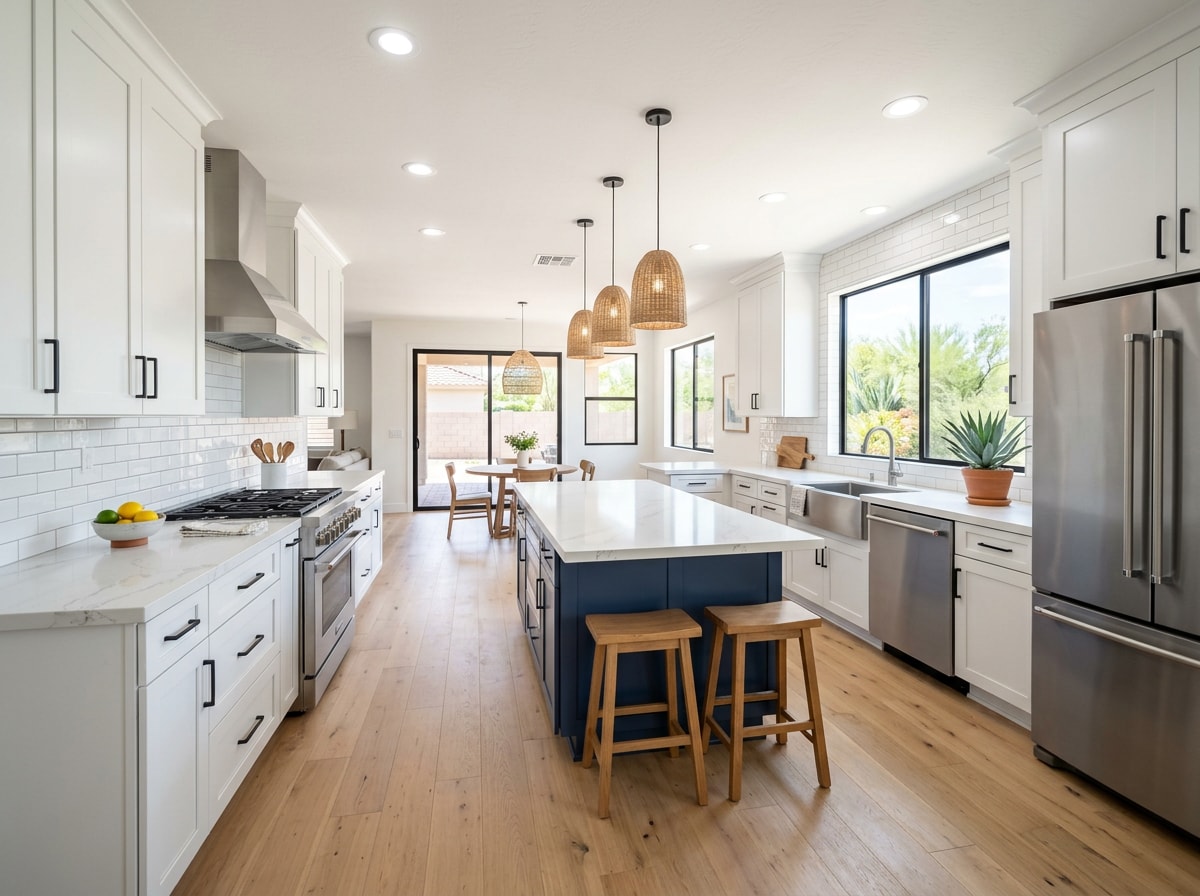
Our own crews run into this constantly. On a 1962 block home west of downtown, we opened a kitchen wall and found the range circuit spliced in a cavity with no junction box. The correction added cost and four days, and it went through as a signed change order before anyone touched it. That is the difference between local pattern recognition and a guess.
Can You Provide References and Completed Projects I Can Visit?
"Were you happy?" produces nothing useful. Ask past clients four sharper questions:
- Did the final cost land near the original contract number?
- What surprise came up, and how was it priced?
- How often did you hear from the contractor?
- Would you hire them again for something bigger?
Then ask to walk a recently completed job. On site, look at the details nobody photographs: caulk lines, trim returns, paint edges at the ceiling, and how new drywall meets existing texture.
References are also a filter in themselves. A busy, reputable builder can still produce three phone numbers in an afternoon. Being "too busy" to show completed work is a decline dressed up as a scheduling problem.
If you are comparing firms, start with builders who actively work your area. You can review our Glendale service area and browse finished project examples before you call anyone.
Who Will Actually Be on My Jobsite?
The person who sells the job is frequently not the person who performs it. Ask which portions are self-performed in-house and which go to subcontractors.
Then ask how long those trade partners have worked with the company. Long-standing sub relationships produce more predictable results than crews assembled per job.
Two follow-ups worth asking out loud:
- Who provides daily supervision, and are they on site or splitting time across four projects?
- Does every sub touching a licensed trade hold their own valid ROC classification?
The general contractor's license does not extend down to subs. Each licensed trade needs its own.
What Does the Estimate Include, and What Is Excluded?
Collect at least three detailed proposals. The lowest number is usually the least complete one, because incomplete bids are cheap to write.
Exclusions decide the real price. Read every quote for allowances (cabinets, tile, fixtures, countertops), permit fees, dump and haul-off, temporary power, and any finish materials you are expected to supply.
Then normalize the numbers. Here is the same Glendale kitchen, bid three ways, using figures from a scope we priced locally:
| Line item | Bid A | Bid B | Bid C |
|---|---|---|---|
| Base contract price | $38,400 | $46,200 | $44,900 |
| Cabinet allowance carried | $6,000 | $11,000 | $9,500 |
| Permit fees | Excluded (+$1,200) | Included | Included |
| Dump and haul-off | Excluded (+$900) | Included | Included |
| Electrical sub | Owner-supplied (+$2,800) | Included | Included |
| Normalized total | $48,300 | $46,200 | $46,400 |
The cheapest bid became the most expensive once the same cabinets and the same permit appeared in every column. That arithmetic is the entire point of collecting multiple bids.
Ask each bidder to price an identical written scope. If one of them will not, you have learned something. See how scope is defined on our kitchen remodeling and room addition pages before you request pricing.
What Your Written Contract Must Include
Arizona residential work above the licensing threshold belongs under a written contract, and a one-page proposal is not one. The document should name both parties and the ROC number, define scope, list materials and allowances, set price and payment terms, give start and completion dates, and spell out warranty and dispute resolution.
Three clauses carry most of the financial risk.
Payment Schedule, Deposits, Lien Waivers, and Retainage
Tie money to milestones, not to the calendar. A draw schedule releases funds as defined phases finish: demo complete, rough-in inspected, drywall hung, substantial completion.
No legitimate general contractor asks for the full contract amount up front. None asks for cash.
Deposit norms vary by project size, trade, and how much custom material must be ordered early. Confirm what is customary for your scope before you accept any figure as standard. A deposit that represents a large share of the total deserves an explanation you can match against actual material orders.
At each draw, ask for lien waivers from the subs and suppliers paid from that draw. Otherwise a paid contractor's unpaid sub can still lien your home.
Hold retainage, a small final percentage, until every punch list item is signed off.
Change Order Process
A change order is triggered any time work departs from contracted scope. You pick a different tile, or demo exposes something nobody could see.
The contract should require written pricing and schedule impact, approved by both parties, before that work proceeds.
Concealed conditions are the common Glendale example. Open a wall in a 1960s block home and find undersized wiring, a plumbing line that has to move, or hidden moisture that turns into a mold remediation scope. Handled properly, you get a signed change with a number attached. Handled poorly, you find the overrun on the final invoice.
Warranty Terms
Two warranties cover your project, and they route to different people.
- Workmanship warranty. From the contractor. Covers installation: flashing leaks, doors out of square, failing grout.
- Manufacturer warranty. From the product maker. Covers the shingle, window, or appliance itself.
Get the warranty period, the exclusions, and the callback process in writing, including who to call and the expected response time. A verbal "we stand behind our work" disappears the moment the crew does.
If a dispute ever escalates past warranty language, it helps to know the routes in advance. Our guide on suing a general contractor in Glendale covers the deadlines that apply.
Permits, Inspections, and the Pre-Construction Plan
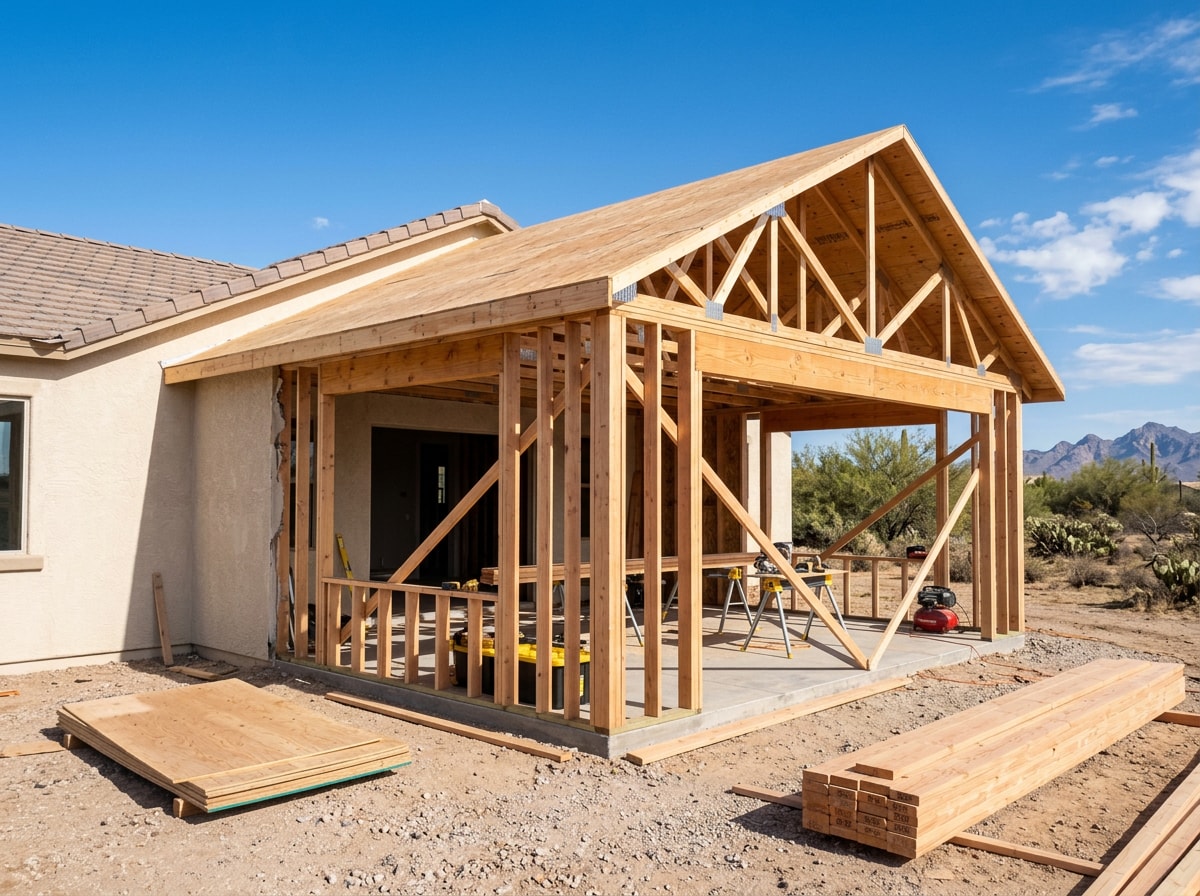
In Arizona the building permit attaches to the property, even though most contractors file it and fold the fee into the contract. Settle in writing who submits, who pays, and who schedules inspections.
In Glendale, property owners, licensed contractors, or authorized agents may apply for a building permit, and contractors must be licensed by the Arizona Registrar of Contractors and provide their license number. Structural changes, additions, re-roofs, electrical and plumbing alterations, water heater replacements, and pool work typically require permits. Confirm your specific scope with the City of Glendale building permits office before assuming a small job is exempt.
Inspections also gate your payment schedule. A draw tied to "rough-in complete" should mean rough-in passed, with the inspection record to show it.
One red flag deserves a name. If a contractor pushes you to pull the permit under your own name, they are moving liability, and often a licensing problem, onto you.
Ask for a written pre-construction plan covering permits, sequencing, site protection, and daily cleanup. You can see how that fits into a full project on our general contractor services page.
EPA Lead-Safe Certification for Pre-1978 Homes
If your home was built before 1978, renovation that disturbs painted surfaces triggers federal lead-safe requirements. Anyone paid to perform work that disturbs paint in housing built before 1978 must be certified in lead-safe work practices, and that includes all firms, even sole proprietorships.
The firm holds the certification, not just one trained employee. Firms cannot advertise or perform covered renovation activities in pre-1978 homes without firm certification , per the EPA Lead Renovation, Repair and Painting Program.
A meaningful share of Glendale housing near the historic downtown core predates 1978, so this comes up more often here than in newer subdivisions. Ask for the certified firm number before work begins.
A contractor who has never heard of the RRP rule, or who shrugs at containment, is telling you how the rest of your project will go.
Schedule, Heat and Monsoon Delays, and Communication
Put a milestone timeline in the contract with a start date and a completion date. A verbal "six to eight weeks" binds nobody.
Local conditions move schedules in ways generic advice misses:
- Extreme summer heat affects concrete curing, stucco, paint, and roofing adhesives, and often pushes crews into early-morning windows.
- Monsoon season brings site access problems, water intrusion risk, and re-sequencing of exterior work from roughly July through September.
- Permit review and material lead times can outlast the physical build on small projects.
Set the reporting expectation up front: what format updates take, how often they arrive, and who your single point of contact is.
Then ask for one concrete example of a past delay and exactly how that client found out about it. Vague answers here predict vague answers later.
Red Flags: When to Walk Away
These warning signs usually surface in the first two conversations:
- Requests cash only, or a deposit with no receipt and no written record
- Will not produce a written contract, or wants to start on a handshake
- Cannot or will not give an ROC number on request
- Pressures you to decide today, or quotes a price that expires by evening
- Gets defensive about licensing, insurance, or references
- Has no references and no completed work to show
- Shows up door-to-door after a storm with "leftover materials"
- No verifiable physical address, only a cell number and a magnetic door sign
One softer signal counts as much as the rest. If numbers shift between conversations and questions keep getting deflected with charm, that evasiveness is data.
When you are ready to run a vetted builder through this list, get a free estimate or start with an overview of our work at Black Ridge Co.
FAQ
What should I look for in a general contractor in Glendale, AZ?
An active ROC license in a classification that matches your scope, current workers' compensation and general liability coverage, a valid bond, and recent projects of your type nearby. Add a written pre-construction plan and reachable references before you sign anything.
How do I check if a contractor is licensed in Arizona?
Search the ROC database by license number or legal business name, then open the full record. Confirm status, classification, bond, complaint history, and qualifying party. Make sure the legal name matches the name on your contract and invoices.
Do I need a permit to remodel a home in Glendale, AZ?
Usually yes for structural work, additions, re-roofs, electrical and plumbing alterations, water heater swaps, and pools. Property owners, licensed contractors, or authorized agents may apply for the permit in Glendale. Confirm your specific scope with the city before work starts.
What does a general contractor actually do?
Plans and sequences the work, pulls permits, hires and supervises subcontractors, orders materials, coordinates inspections, and manages budget and timeline. You are paying for that coordination, not just labor.
Should I get multiple bids before choosing a contractor?
Yes. Get at least three detailed written proposals, then compare them line by line on identical scope, allowances, and exclusions. Bids only help after you normalize them, as shown in the table above.
How much can I recover if a Glendale contractor abandons the job?
The maximum individual award from the Arizona residential contractors' recovery fund is $30,000 , and payouts are capped at $200,000 per residential license . The fund is not available to homeowners who hired an unlicensed contractor or one whose license was expired, suspended, or revoked at the time of contract.
How long does a construction project take in Glendale?
It depends on scope. A bathroom refresh can run a few weeks, while an addition can run several months. Permit review, material lead times, and weather move the schedule most. Any firm timeline quoted before scope is defined is a guess.
Who is liable if a worker is injured on my property?
If the contractor carries current workers' compensation, the claim goes to their carrier. If they do not, the exposure can shift to you and your homeowner policy may limit or exclude it. Verify coverage with the carrier, not with a forwarded PDF.